
Therapeutic Plasma Exchange, also called plasmapheresis, has been showing up in the media lately in podcasts, documentaries, and wellness articles. And every time it does, the same reaction floods the comments:
“Wait, isn’t that what I did in college for beer money?”
“I donate plasma every two weeks. Sounds like rich people are just paying to do what broke college kids already figured out.”
It makes complete sense that people go there. For most of us, the only context we’ve ever had for plasma is donating it at a collection center for $20–$40. So when you hear about a medical procedure involving bags of plasma and something called an “oil change for your blood,” the brain connects the dots to the nearest familiar thing.
But plasma donation and Therapeutic Plasma Exchange are not the same thing. Not even close. And understanding why tells you almost everything you need to know about what TPE actually does, and who it’s actually for.
I’m an Integrative and Functional medicine physician who’s taken a deep dive into the TPE research (i.e. The AMBAR study) for the past couple of years and seen its benefits firsthand in my patients. With Therapeutic Plasma Exchange (TPE) coming soon (June 2026!) to Olos, I find myself explaining the in’s and out’s of TPE to patients, to curious friends, and apparently now to comment sections everywhere.
So let’s start with the most common question: if your body already replaces its own plasma every 48 hours, what’s the point of paying for a procedure to do it?
First: What Is Plasma, and What Does It Actually Do?
Before comparing the two procedures, it helps to understand what plasma actually is.
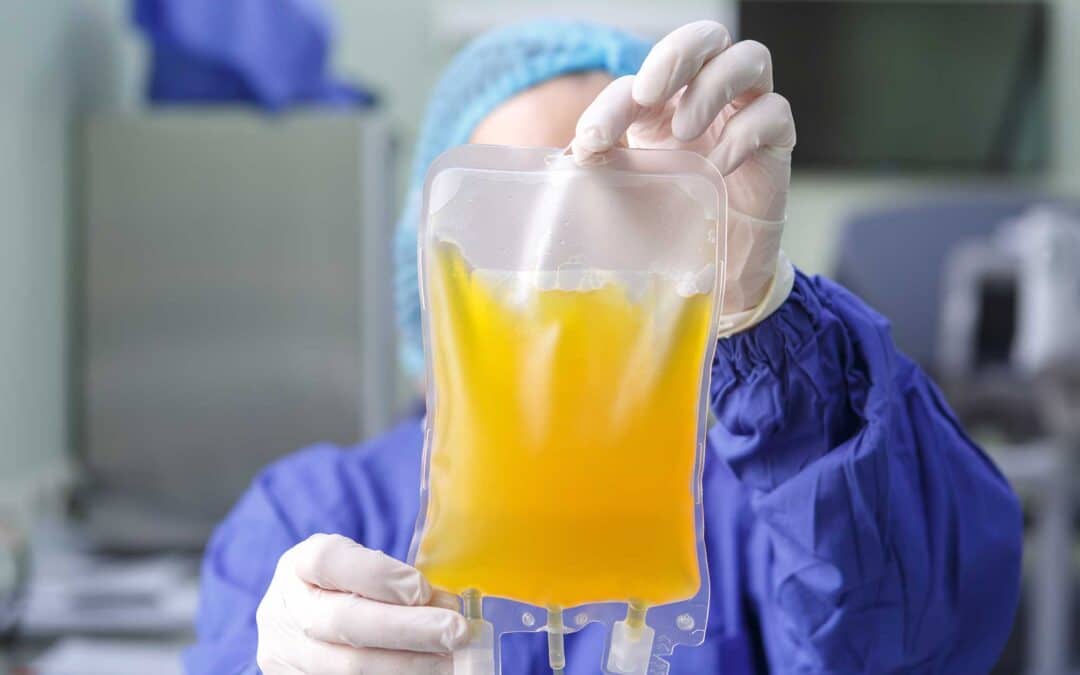
Plasma is the liquid component of your blood: the pale yellow fluid that makes up roughly 55% of your total blood volume. It’s not just a carrier fluid, as plasma is biologically active. It contains:
- Proteins including albumin, fibrinogen, and clotting factors
- Antibodies and immunoglobulins produced by your immune system
- Hormones traveling to target tissues
- Electrolytes that regulate fluid balance
- Nutrients being transported throughout the body
- Waste products being carried to the kidneys and liver for processing
In a healthy person, plasma is a clean, balanced biological environment. But in someone with chronic illness, plasma can become a vehicle for dysfunction, carrying inflammatory proteins, autoantibodies, immune complexes, circulating toxins, and other substances that drive ongoing disease.
“Your Body Already Replaces Its Own Plasma Every 48 Hours…. So What’s the Point?”
This is the most common objection, and it’s worth taking seriously. Yes, it’s true. When you donate plasma, your body regenerates it within 24–48 hours. So the question is fair: if your body already does this on its own, why would you pay for a medical procedure to do it?
The answer is in what your body puts back.
When your body regenerates plasma after donation, it doesn’t produce plasma from scratch in a neutral state. It produces plasma that reflects your current biology. Your immune system, your inflammatory status, your toxic burden, your ongoing disease processes, etc., and all of these continue to shape what goes into your new plasma.
Think of it this way: if you have a river that’s been contaminated by a source upstream, draining part of the river and letting it refill doesn’t solve the problem. The contamination source is still there, and the new water picks up the same contaminants as it flows through.
In someone with a serious chronic illness (like autoimmune disease, Long COVID, mold illness, and chronic Lyme), the body is continuously producing the very substances that are making them sick:
- Autoantibodies that attack the body’s own tissues
- Inflammatory cytokines that sustain chronic inflammation (Long Haul Covid, MCAS)
- Immune complexes that deposit in tissues and drive symptoms
- Circulating biotoxins (in mold illness and Lyme) that the body cannot effectively clear
When plasma is removed through donation and the body regenerates it, these substances are replenished along with everything else. The temporary reduction in their volume may provide mild, short-term relief, but the underlying burden rebuilds quickly.
This is not a flaw in plasma donation. Plasma donation isn’t designed to treat disease; it’s designed to collect biological material for medical use. It was never intended as a therapeutic intervention.
What Happens When You Donate Plasma?
When you donate plasma at a collection center, you go through a process called plasmapheresis; the same root word as therapeutic plasmapheresis, which is where the confusion often starts.
Here’s what actually happens:
- Blood is drawn from one arm and passed through a centrifuge
- The centrifuge separates your blood into its components: red cells, white cells, platelets, and plasma
- The plasma is collected and set aside
- The remaining blood components are returned to your body, usually mixed with saline to maintain volume
The whole process takes about 45–90 minutes. Your body begins regenerating plasma almost immediately, and within 24–48 hours, your plasma volume is largely restored.
So yes, your body absolutely regenerates plasma after donation. The question (as we’ve established) is what that new plasma contains.
What Toxins Are They Actually Removing?
Skepticism can assume “toxins” is vague wellness-speak with no clinical meaning. In the context of plasma exchange, it isn’t. Here’s what is specifically and measurably removed:
- Autoantibodies (immune proteins that attack the body’s own tissues)
- Inflammatory cytokines (signaling proteins that sustain chronic inflammation)
- Immune complexes (clusters of antibodies and antigens that deposit in tissues)
- Circulating biotoxins (mycotoxins from mold, endotoxins from bacterial infections)
- Microclots and fibrin fragments (increasingly documented in Long COVID)
- Excess lipoproteins and other plasma proteins that accumulate with certain conditions
These are not abstract concepts. They are measurable on lab work before and after treatment. The reduction in these markers (and the corresponding improvement in how patients feel!) is what makes TPE a legitimate clinical tool, not a wellness trend.
So What Is Therapeutic Plasma Exchange Actually Doing Differently?
Therapeutic Plasma Exchange (TPE, or also known as plasmapheresis in clinical settings) is a medically supervised procedure that removes a significant volume of plasma and immediately replaces it with a clean replacement fluid, typically albumin solution.
This distinction matters enormously.
In plasma donation: Your plasma is removed. Your body eventually regenerates new plasma, shaped by your ongoing disease state.
In TPE: Your plasma is removed and immediately replaced with a neutral, clean carrier fluid (albumin). This does several things simultaneously:
- Removes the burden — inflammatory proteins, autoantibodies, immune complexes, and circulating toxins are physically taken out of circulation
- Maintains blood volume safely — the replacement fluid keeps your cardiovascular system stable throughout the procedure, which is why TPE can remove significantly more plasma than donation
- Creates a window for recalibration — with the accumulated burden cleared, the immune system has a genuinely clean environment in which to begin rebalancing
This whole process is targeted removal followed by an active reset, not just volume reduction.
Why Can’t I Just Donate Plasma Frequently to Get the Same Effect?
Even if you donated plasma as frequently as centers allow, you wouldn’t replicate the therapeutic effect of TPE. Here’s why:
Volume limitations. Plasma donation centers typically collect 690–880 mL per session. A single TPE session removes 1–1.5 plasma volumes (typically 2,500–4,000 mL) in a carefully monitored clinical setting. The therapeutic dose matters. Removing a small fraction of plasma volume has a fundamentally different effect on inflammatory burden than removing and replacing a full plasma volume.
No replacement fluid. Plasma donation doesn’t replace what’s removed with anything therapeutic. In TPE, the replacement with albumin solution is what makes large-volume removal safe and what creates the clean biological environment for healing.
No clinical monitoring. TPE is performed by a qualified medical professional using an apheresis device with continuous monitoring throughout. The procedure is titrated to the patient’s specific condition, lab values, and protocol. Plasma donation centers are not clinical environments and are not designed to manage patients with complex chronic illness.
The self-replenishment problem. In someone with serious autoimmune disease or chronic inflammatory illness, the body replenishes pathological substances faster than periodic donation could remove them. TPE’s therapeutic effect comes from removing a meaningful portion of the total burden in a single session, not from gradual, incremental reduction over weeks.
Isn’t That What Your Kidneys and Liver Are For?
Yes, the kidneys and liver are your body’s primary filtration systems. But they have limits.
In chronic illness, the filtration burden often exceeds the body’s capacity to clear it. The liver becomes congested. Detox pathways get overwhelmed. The lymphatic system backs up. This is precisely why patients with serious chronic illness feel so persistently unwell despite doing “everything right.” Their body’s natural clearance systems are outpaced by the load.
TPE doesn’t replace the liver or kidneys. It reduces the plasma burden to a level where those systems can actually function effectively again. Think of it as clearing a blocked drain so the water can flow, rather than adding more water and hoping the drain keeps up.
What Does the Research Say?
TPE has been used clinically for decades. It is recognized by the American Society for Apheresis (ASFA) as an evidence-based treatment for over 80 conditions, with formal indications ranging from neurological disorders to autoimmune diseases.
Key research relevant to the conditions we treat at Olos:
- Autoimmune disease: TPE has established clinical evidence for conditions including myasthenia gravis, Guillain-Barré syndrome, lupus (SLE), and ANCA-associated vasculitis. [ASFA Guidelines — Journal of Clinical Apheresis, 2023]
- Long COVID: Emerging research suggests that plasma-borne microclots, spike protein fragments, and elevated inflammatory cytokines may contribute to post-acute sequelae of COVID-19 (PASC). A 2022 study documented improvement in Long COVID symptoms following apheresis. [Pretorius et al., Cardiovascular Diabetology, 2021]
- Neurological / cognitive symptoms: The AMBAR study demonstrated that repeated plasma exchange with albumin replacement slowed cognitive decline in moderate Alzheimer’s disease. [AMBAR Trial — Alzheimer’s & Dementia, 2020]
- Biotoxin illness: Clinical application of TPE in chronic inflammatory response syndrome (CIRS) and mold-related illness is an area of active investigation among functional and integrative medicine practitioners, with case series and clinical experience supporting its use for patients with high biotoxin burden.
Note: TPE is a prescription procedure. It is not appropriate for everyone, and clinical outcomes vary. All patients at Olos receive a comprehensive evaluation before TPE is recommended.
Is Plasma Donation Ever Beneficial for Health?
To be fair: there is some emerging research suggesting that regular plasma donation may have mild health benefits in generally healthy people, not because of what’s removed, but because it stimulates the body to produce fresh proteins and may have modest effects on some inflammatory markers.
A 2019 study published in Nature Medicine found differences in plasma protein profiles across the lifespan, and some longevity researchers have speculated that the regenerative stimulus of plasma donation might carry minor incidental benefits for otherwise healthy individuals.
But this is very different from what we’re discussing at Olos. For a generally healthy person, plasma donation is a generous act that saves lives: the donated plasma is used to make life-saving medications and treat patients with serious conditions. For a person with serious chronic illness carrying a significant plasma burden, it is not a therapeutic substitute for TPE. The mechanism, the dose, the clinical context, and the intent are entirely different.
The Bottom Line
If you’ve been wondering whether plasma donation could give you the benefits of Therapeutic Plasma Exchange, it’s a smart question, and it speaks to how intuitive the core concept of TPE really is.
But the differences are significant:
| Plasma Donation | Therapeutic Plasma Exchange | |
| Volume removed | 690–880 mL | 2,500–4,000 mL |
| Replacement fluid | Saline only | Albumin solution |
| Clinical oversight | Donation center staff | Qualified medical professional |
| Purpose | Collect plasma for medical use | Treat disease / reduce inflammatory burden |
| New plasma source | Your body (disease-influenced) | Replaced immediately with clean fluid |
| Appropriate for chronic illness | No | Yes, with proper evaluation |
TPE isn’t a shortcut or a biohack. It’s a serious clinical tool, and one that’s been used in hospitals for decades and is now being applied thoughtfully in functional and integrative medicine settings for patients with complex chronic illness. Something that can clear the accumulated burden that stressed bodies can no longer clear on their own.
Ready to Learn More?
If you’re living with a chronic condition and wondering whether TPE might be part of your healing path, we’d love to talk.
TPE isn’t a magic solution, but for the right patient, it can be the thing that finally allows the body to catch up with all the hard work you’ve already put in. TPE will be offered at our Hudson location beginning in June 2026.
Wherever you are in your journey, we’d be honored to be part of what comes next.
Dr. Kat Hopkins is the founder of Olos Medicine, a functional and integrative medicine practice with locations in River Falls and Hudson, Wisconsin. She specializes in complex chronic illness, autoimmune conditions, Long COVID, and mold illness, and offers Therapeutic Plasma Exchange as part of a comprehensive, personalized approach to healing.
References
- Padmanabhan A, et al. Guidelines on the Use of Therapeutic Apheresis in Clinical Practice. Journal of Clinical Apheresis. 2023. American Society for Apheresis (ASFA). https://www.apheresis.org
- Pretorius E, et al. Persistent clotting protein pathology in Long COVID/Post-Acute Sequelae of COVID-19. Cardiovascular Diabetology. 2021. https://doi.org/10.1186/s12933-021-01359-7
- Boada M, et al. Treatment of Alzheimer’s disease by albumin replacement: Rationale and study design of a phase 2b/3 clinical trial. Alzheimer’s & Dementia. 2020. https://alz-journals.onlinelibrary.wiley.com/doi/10.1002/alz.12137
- Lehallier B, et al. Undulating changes in human plasma proteome profiles across the lifespan. Nature Medicine. 2019. https://doi.org/10.1038/s41591-019-0673-2
- Fresenius Kabi. Therapeutic Plasma Exchange: A Patient Guide. 2023. https://www.fresenius-kabi.com/us